
Ohio County's Most Wanted Program
Ohio County runs no most-wanted program, no dedicated roster, no fugitive feature, and no sheriff-sponsored Crime Stoppers list. What it offers instead is a direct contact route. The Ohio County Sheriff page publishes an address and a general phone number, though it carries no searchable warrant list or lookup form. That absence means no public program exists, not that Ohio County has no active warrants. Plenty of outstanding warrants can sit with nothing posted anywhere. Elsewhere, a typical program spotlights a handful of high-priority subjects picked by the sheriff. Ohio County publishes no selection criteria, update cycle, or removal policy, and those practices cannot be borrowed from another county. If an official list appears later, read that government source first, and still confirm a subject's status with the agency that holds the warrant.
No Ohio County Roster Located
With no roster to scan, an Ohio County warrant check runs on details. Write down the full legal name, date of birth, case or citation number, and the court involved. For service or custody questions, call the Sheriff at (812) 438-3636. For a court-file event, call the Ohio County Clerk at (812) 438-2610. The Sheriff sits at 123 S. Mulberry Street in Rising Sun. The Clerk is in Room 207 at 413 Main Street.
Quick answer: Ohio County publishes no official most-wanted list, and a missing roster does not prove that no warrant exists.
The official Sheriff contact page shows the county channel available to the public.
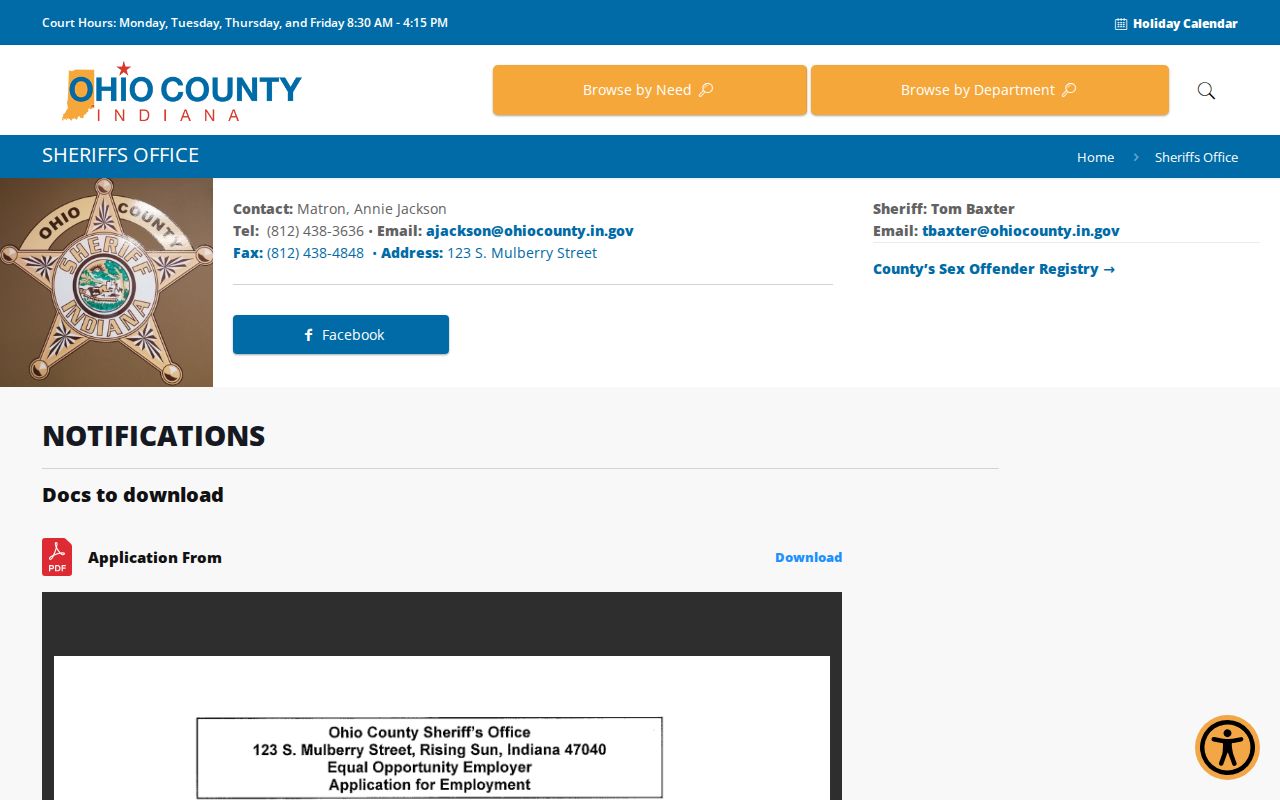
The captured page supports direct contact without exposing any person's private case details.
How the Most Wanted Lists Work
Where a most-wanted list exists at all, it works as a curated public notice rather than a full register of open warrants. What gets published usually reflects enforcement priority, the alleged offense, how hard someone is to locate, or a need for public help. Ohio County posts no criteria, update schedule, or removal policy, so no claim about local practice can be made. Even an official list is only a snapshot. An arrest, a surrender, a recall, service, or a new court order can change a status the day after publication. Records can also be restricted. No roster substitutes for current confirmation from the clerk, the issuing court, or the sheriff.
Note: A person may have an active warrant without appearing on a most-wanted list, while an old listing may lag the court record.
Ohio County Case Search Limits
Indiana MyCase is the statewide public case tool, and it reaches nonconfidential Ohio Circuit Court cases. Search by case number, citation number, cross-reference number, or party name. Party searches need a last name. A first name, middle name, or birth date can narrow things down. Filters for court, case type, status, and file date help too. Wildcards and sounds-like search cover odd spellings. Keep in mind, MyCase is not an Ohio County most-wanted program. A chronological case summary may show a hearing, an order, or a warrant event. Yet public access can omit sealed, confidential, juvenile, old, or unavailable documents, and live service status may not appear. Use a result to identify a case, then ask the clerk whether the warrant entry is current. Never treat a common-name match as a safe identification.
Reporting a Tip Safely
Ohio County publishes no anonymous tip line, tip form, Crime Stoppers partnership, reward schedule, or reward-claim process. So do not promise anonymity or money. For nonemergency information, call the Sheriff's general phone and ask how the agency prefers to receive facts. Use 911 only in a true emergency.
- Record the place, time, vehicle, direction, and facts directly observed.
- Call the Sheriff at (812) 438-3636 and ask for the proper reporting channel.
- State facts rather than guesses, and do not post a location online.
- Do not approach, follow, detain, or warn anyone; let officers act.
Key point: Ohio County sets no anonymity or reward terms, so ask the Sheriff about privacy before sharing identifying information.
Ohio County Registry Is Different
The Sheriff page links a sex-offender registry, and the two records are easy to confuse. That registry is not an active-warrant list. It does not show that a registrant has a current warrant. Registration belongs to a separate legal system, and reading it as a warrant check invites a false conclusion. Indiana's tax-warrant search and 2026 tax-amnesty materials follow the same rule. A tax warrant concerns tax debt. It is not a criminal arrest warrant or a county most-wanted notice. Ohio County runs no criminal warrant roundup or criminal amnesty event, and a state tax program cannot fill in missing local facts.
Most Wanted Lists vs Active Warrants
A most-wanted notice and an active warrant differ in legal effect. The notice is simply a publication choice. The warrant is a court order, tied to the issuing court's file and to the return law enforcement makes on it. Ohio County offers court and agency channels, not a county program.
| Feature | Most-wanted list | Active warrant |
|---|---|---|
| Scope | Selected public subset, if any | Any unserved or unresolved warrant |
| Ohio County source | No roster located | Confirm through court, Clerk, or Sheriff |
| Online meaning | May lag current events | Case entry may need live confirmation |
| Resolution | Publication does not control the case | Issuing court controls recall or relief |
Dropping a name from a web page would not recall an Ohio County warrant, and absence from one would not clear it.
Ohio County Agency Identity Changed
Ohio County's law enforcement map shifted in spring 2024. Rising Sun's city police officers, buildings, and gear all moved into the Ohio County Sheriff's Department. The Sheriff kept its Rising Sun office and took over the former police building too. So an old ticket or notice may still show the city police name. For anything current, though, the county Sheriff is the office to call.
That shift explains a common dead end. A relative remembering city police hunts for a roster that no longer exists as a separate thing, and the city site now points to the Sheriff rather than a police warrant desk. Neither the city nor the county publishes its own most-wanted list. Bring routine warrant questions to the Sheriff or the Clerk, not to 911.
Ohio County Warrant Status Terms
Status words on a warrant entry are easy to overread. What they mean depends on the court file and a law-enforcement return. Ask the Ohio County Clerk to explain the latest entry instead of trusting an old image.
- Active
- Recorded as open, with no shown service or recall.
- Served
- Law enforcement executed the warrant and returned it to court.
- Recalled
- The court withdrew its warrant. Payment alone does not prove recall.
- Cleared
- A broad label that needs the underlying event explained.
- Failure to appear
- A missed required date that can lead to a warrant.
A warrant authorizes action while the allegations remain part of the court process.
Ohio County Records Request Route
Indiana's Access to Public Records Act generally lets you inspect and copy public-agency records during business hours, as long as your request identifies the record with reasonable particularity. Name the agency, the record type, the date range, and the case or citation number. Then ask for the nonconfidential status or case record. Keep the routing simple: court records go to the Clerk, and law-enforcement records go to the Sheriff.
Ohio County offers no online request vendor, warrant form, special fee, or response-time promise for this. Investigatory records may be withheld at the agency's discretion. Records that law, court rule, juvenile law, or a court order makes confidential cannot be released. The Indiana Public Access Counselor can help with access questions.
If You Think You Are on a List
With no verified roster in Ohio County, work the underlying case instead. Search MyCase with a case or citation number if you have one. Call the Clerk to confirm whether the chronological case summary shows a current warrant event and which court issued it. An attorney can review the file and ask the court about recall, bond, a new date, or a planned surrender.
The Sheriff handles service and custody, nothing more. Only the court can recall or resolve a warrant. Do not assume an online payment, a message, or an empty search result ends anything. Keep your receipts and orders, then check that the court record actually changed.
Important: Consult an attorney before appearing in person. Counsel can confirm status and help plan a lawful court appearance or surrender.